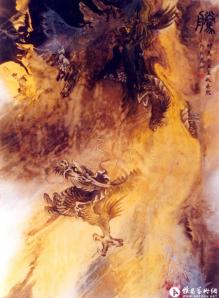
Chinese Dragon Mythology

Long, Chinese character for dragon

There five different Chinese Dragons (chin. Long) species are following:

  1. celestial dragons who guard the abodes of the gods
  2. treasure-guarding dragons; guards precious metals and stones
  3. dragon spirits, who rule over wind and rain but can also cause flooding
  4. earth dragons, who cleanse the rivers and deepen the oceans
  5. imperial dragons; dragons with five claws instead of the usual four

Dragon Zeichn

Asian Dragons are rarely depicted as malevolent in contrast to western mythology.

In Chinese philosophy the dragon corresponds to springtime, the color green/blue and element wood is also representing the east of the four directions. The Chinese dragon is fearsome and benevolen at the same time and the bringers of wealth and good fortune.

From time to time pictured with its counterpart the Phoenix. It painted an other symbol of Yin and Yang. Dragon and Phoenix symbolism associated with the imperial family.Dragon the emperor and phoenix the empress. Only the imperial family were allowed to wear this symbol on yellow robes. The „ImperialDragon“ of the Celestial Kingdom(China) is the only one who has five claws. The Chinese emperor Yao one of the five primal emperor it was said he was a son of a dragon.

If the dragon is painted with the tiger he represents the yin but painted with the phoenix the yang. Often alone portrayed surrounded by clouds and water who shows he associated to the watery realms. Also said Dragons are to be shape shifters, and may assume as human body. 
Zen- quotes, Zen- phrases, Zen-trum, Wei-Zen, Zen-tral, Kat-Zen, Zen-nith….

Here it is the Zen wisdom of knowing and not knowing or better just do it. If you try to catch it you will suddenly wake up in a storm of your monkey mind means busy mind.

Just read in mindfulness because this is the door of the present moment. Better without criticism or judgment but with your full attention. So just shut all senses and breath and catch it or not hahaha

ZenKreis_01-100px-tp

  • If we are facing in the right direction, all we have to do is keep on walking.
  • When Im eating I´m eating, when I´m sleeping I´m sleeping, when I´m drinking I´m drinking…mhhh thats it?
  • open the mind and shut the mouth
  • do not judge and you will find peace within
  • it is like it is
  • Before enlightenment, chop wood, carry water, after enlightenment chop wood, carry water. 

Grundlagen der Achtsamkeit…Sattipatthana Sutta_ short cut

Dieses Sutta hat Buddha selbst als den Pfad bezeichnet der es jeden Menschen ermöglicht Frieden in Körper und Geist zu finden; Kummer und Leid zu tilgen des weiteren höchste Einsicht und vollkommene Befreiung zu erlangen.

Hier die Essenz des Sattipatthana Sutta oder auch „Sutra über die Vier Grundlagen der Achtsamkeit:

Man nimmt achtsam alles wahr; im Körper, in den Empfindungen, im Geist sowie den Objekten des Geistes. Dies nennt man auch Bewusstheit in jedem Moment.

  • Körper beobachten> den Atem und die vier Körperhaltungen> im gehen, liegen, stehen, sitzen ist sich dabei allen Körperteilen bewusst. Muskeln, Knochen, Haut und Haar der inneren Organe, Knochenmark, Speichel und Schweiß. Den körperlichen Zerfall.


  • Empfindungen beobachten> wann sie entstehen, sich entwickeln und vergehen; angenehm, unangenehm oder neutral; Ursprung ist entweder der Körper oder Geist, schaut genau hin so könnt ihr die Empfindung besänftigen und ihren Ursprung wahrnehmen

Hier kann man klar erkennen das für eine große Aufmerksamkeit die Meditation bzw. Aufmerksamkeitszustand unabdingbar ist um sich diesen feinstofflichen in der tiefe gewahr zu sein.


  • Geist beobachten> wissen, erfahren im welchen Zustand der Geist sich gerade befindet; ist er konzentriert, verwirrt,schläfrig oder zornig, begehrt er was oder nicht, wir sind uns dessen durch unsere Aufmerksamkeit bewusst. Man kennt seinen Geisteszustand der im gegenwärtigen Moment entsteht und sich seiner Bewusst.


  • Geistesobjekte beobachten>  die fünf Hindernisse der Befreiung (Sinnesbegierde, Feindseligkeit,Trägheit, Ruhelosigkeit, Bewusstsein) wann immer sie erscheinen; die fünf Skandhas die die Persönlichkeit ausmachen(Körper, Empfindungen, Wahrnehmungen, Geistesregungen, Bewusstsein); die sechs Sinnesorgane und Sinnesobjekte; sieben Faktoren des Erwachens (Volle Aufmerksamkeit, Dharma- Ergründung, Energie, Freude, Wohlgefühl, Konzentration und Gleichmut) und die „Vier edlen Wahrheiten“. Dies alles sind die Objekte des Geistes.


how to find a master…my first week

after my decision to start my search for master I booked my train ticket from Frankfurt to Budapest  from there I heard I can  to get cheap ticket for the transsiberian train.

Ok 1989 Hungary was not very luxury because first year of democracy and capitalism. The border were open to import goods from western countries. It was wintertime and close to christmas the people there and especially the children where looking with wide open mouth at the shopping windows. For me nothing special to see only new TVs or toy trains. But the children eyes were shining like they where looking at wonder of the world. It was the first time they could see such things but also I could see they did not have the money to buy it. This was a country in Europe for me not understandable how it could be. The things I was reading in the newspaper became true for me, east and west, capitalism and communism, cold war…To see it, feel it or just read it a big difference and it was making me sad. In the train or busses I was taking the smell of vodka or what ever kind of alcohol always present, the frustration to see the luxury stuff in the shopping window but no money to buy it. With these pictures of the reality I was living around one week in a small apartment in a  building made with precast concrete slaps. The landlady was catching me at the train station after my arriving in Budapest. She was showing me pictures to catch me for hiring her privat room, cheap, cheap so far I remember correct, where her only words in broken english.  Indeed it was quite cheap around 5 US for a day and the smell of alcohol from my landlady  Drachen by Dong Wencheng (1938-

For one week every morning the same action. I went to the station and was asking for a train ticket to china

Frühling was tun? Springtime and now ?

Ja da ist nun wieder Frühling, Mensch und Natur blühen wieder auf. Graues Winterkleid weicht mehr und mehr dem farbfröhlicheren, das Lächeln fällt den Mitmenschen immer leichter nach der trüben,kalten und dunklen Winterzeit. Naja dieses Jahre war es von Temperaturen eher kein Winter jedoch die Emotionen sind trotzdem in dieser Zeit eher cool/ kühl. Liegt wohl daran das sich die Lebensenergie in der Winterzeit sich nach innen zurückzieht sich speichert. Das Qi (Lebensenergie) warten dann nur darauf wieder aktiver zu werden, so wie es Natur um uns herum auch zeigt. Den wir sind energetisch ein Abbild des Makrokosmos / Natur und wir als Mikrokosmos den gleichen Gesetzen unterworfen. Da helfen keine Pillen hahaha, auch wenn es hier und da so angepriesen wird.

Japanblüten


Also was ist jetzt das Richtige? Die klassische chinesische Medizin, die ihr Wissen von der viel älteren daoistischen Tradition hat, sagt folgendes zum Frühlingsverhalten:

  • früh in Bett
  • aber auch früh aufstehen
  • sich Zeit nehmen den morgendlichen Vogelgesang zu lauschen
  • Morgengymnastik, Dehnübungen, Qi Gong, Frühspaziergang, Augenübungen
  • Leber entgiften helfen (z.B. Alkohol fasten)
  • gute Zeit für Visionen / Zukunftspläne
  • schauen was uns diese Zeit an Lebensmittel bereithält und diese vermehrt zu sich nehmen

Dies sind nur einige Beispiele wie die Frühlingszeit energetisch für uns optimiert werden kann. Bedeutet einfach nur die beste Anpassung finden und somit den natürlichen mikrokosmischen Geschehnissen Unterstützung geben. Gegen sie zu arbeiten bedeutet nicht das Potential, das in dieser Zeit herrscht zu nutzen, schade eigentlich. Last die Frühjahrsmüdigkeit zu Hause oder so ….